Talvoryx
Cipher Pattern
Cipher Pattern
Couldn't load pickup availability
-
Problem Statement
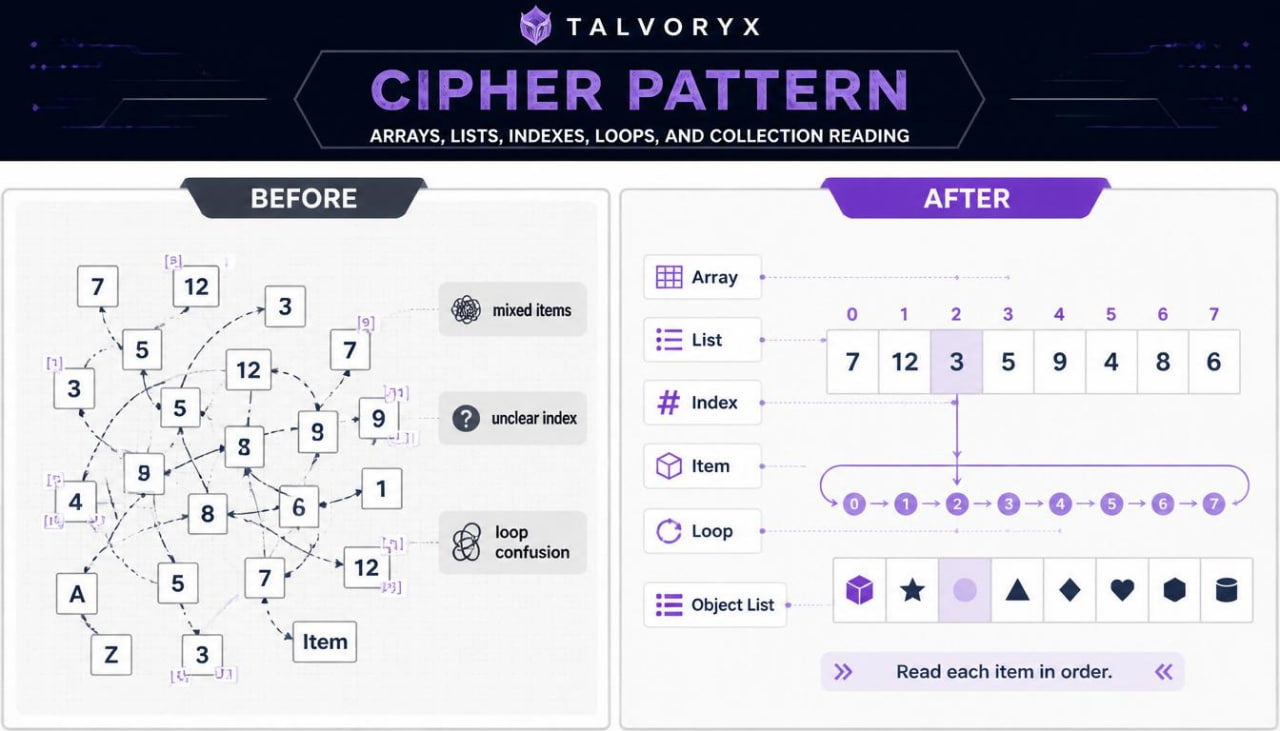
Once learners understand variables, methods, and classes, they often meet a new question: how should code work with many values instead of one value at a time? A single variable can hold one item, but many real examples need groups such as names, numbers, scores, labels, or records. Arrays and lists can look simple at first, yet indexing, counting, adding, removing, and looping through values can become confusing when introduced too broadly. Learners may also struggle to see the difference between a collection itself and one item inside it. Cipher Pattern was created to help learners read collection-based C# examples with a calmer and more organized approach. -
Solution
Cipher Pattern introduces grouped data through written modules, focused examples, review notes, and practice tasks. The course begins with the idea of one value versus many values, then moves into arrays, lists, indexes, loops, and object collections. Each section explains how values are placed into a group, how they are found by position, and how loops can review them one by one. The material also connects collections with earlier topics such as methods, classes, properties, and conditions. This gives learners a structured way to study C# code that works with repeated data patterns. -
What’s Inside
Cipher Pattern begins with a course orientation section. This opening part explains how the modules are arranged and how learners can use the examples, task prompts, recap notes, and glossary pages. It also explains the main theme of the course: studying how C# handles groups of related values. Learners are encouraged to read slowly, trace examples line by line, and pay attention to how one item fits inside a larger collection.
The first main module introduces the idea of grouped values. Before arrays or lists are shown in detail, the course explains why many examples need more than one value. Learners compare separate variables with a single collection that can hold several related items. This section uses simple examples such as numbers, names, labels, and status values. The purpose is to make the reason for collections clear before adding new syntax.
The next module introduces arrays. Learners study how an array can hold several values of the same type. The course explains array declaration, starting values, positions, and length. It also introduces the idea that positions begin with zero in many C# examples. This can feel strange at first, so the material gives several small reading tasks where learners identify the first item, second item, final item, and total number of items.
A full section is dedicated to indexing. This module explains how an index points to one item inside a collection. Learners study examples where a value is read from a position, changed at a position, or compared with another value. The course carefully separates the collection name from the index value and from the item stored at that position. Practice tasks ask learners to label these parts in short lines of C# code.
Cipher Pattern then introduces loops with collections. Learners review how loops repeat actions, then study how loops can move through collection positions. The course explains how a counter can represent an index and how that index can be used to read each item. Examples include counting through numbers, checking text values, and gathering simple totals. The focus stays on reading the movement of the loop rather than writing large examples.
The next module introduces list-style collections. It explains how a list can hold a group of values and how it can be useful when the number of items may change during study examples. Learners read examples where items are added, removed, counted, and reviewed. The course compares arrays and lists through plain explanations, showing that both can hold groups but are often used differently in beginner examples.
A separate section covers common list operations. Learners study adding an item, reading an item by position, checking the number of items, removing an item, and looping through the list. Each operation is shown with a compact example and a short explanation. Review prompts ask learners to predict how a list changes after each line. This helps connect the code statement with the changing collection state.
Cipher Pattern also includes a module on foreach-style reading. This section explains how a foreach loop can review each item in a group without focusing directly on numeric positions. Learners compare index-based loops with foreach loops. The course shows where each style may appear in beginner examples and how to read the variable that represents the current item. This section is especially helpful for learners who find index counters visually crowded.
The course then connects collections with conditions. Learners study examples where each item in a group is checked against a condition. The material may show how to count matching items, find values over a certain number, identify text with a certain shape, or skip values that do not match a rule. The examples remain small so the learner can follow the path of each item through the condition.
Another module connects collections with methods. Learners read examples where a collection is passed into a method, reviewed inside the method, and used to return a result or produce a short summary. The course revisits parameters and return values from earlier tiers, now with grouped values instead of single values. This helps learners see how earlier method knowledge applies to collection-based code.
Cipher Pattern also includes an introduction to collections of objects. This section builds on the earlier class and object tier. Learners study simple examples where several objects are placed inside a list. For example, a class may describe an item with a name and number, and a list may hold several created objects. The course explains how a loop can read each object and then read a property from that object. This section is kept beginner-friendly and focuses on reading rather than complex design.
A practical tracing section brings the course together. Learners are given short C# examples where an array or list is created, values are added or changed, a loop reviews the group, and a condition checks each item. The learner may be asked to follow how the collection changes after each line, identify what a loop is reading, or explain what result is produced by the example. These tasks are written to help learners slow down and notice patterns.
The task pages include several study formats. Some tasks ask learners to identify indexes. Some ask them to complete a missing loop line. Others ask them to compare an array example with a list example, trace item changes, or describe why a foreach loop is used. There are also short review prompts that ask learners to explain the difference between the collection, the index, and the current item.
The recap section gathers the main ideas from the course into organized notes. Learners can review arrays, lists, indexes, length, count, item reading, item changes, loops, foreach reading, conditions with collections, methods with collections, and object lists. The recap is written in compact blocks so learners can return to one topic at a time.
The glossary explains key terms used throughout Cipher Pattern. Terms include array, list, collection, item, index, length, count, position, loop, foreach, current item, add, remove, update, object list, and collection parameter. Each definition is connected to examples from the course so learners can understand the term in context.
-
Who Is This For?
Cipher Pattern is for learners who already know basic C# syntax, methods, and class structure, and now want to study grouped values. It is suitable for learners who can read single-variable examples but feel less certain when arrays, lists, and loops appear together.
This course is also useful for learners who want written materials that explain collection behavior step by step. Instead of presenting large code samples too early, Cipher Pattern keeps examples compact and focused. Learners can study one collection idea, review it, then connect it with another idea.
Cipher Pattern may also suit learners preparing for wider C# topics where lists of objects, repeated checks, and grouped data appear often. Since many practical examples rely on collections, this tier gives learners time to study the reading patterns behind them.
It is also a good fit for learners who enjoy tracing values. If a learner wants to understand which item is being read, which index is being used, and how a loop moves through a group, this course provides focused study pages for those questions.
- What You’ll Learn
- How arrays store several values of the same type
- How indexes point to specific items inside a collection
- How to read and change an item by position
- How length and count describe collection size
- How loops move through arrays and lists
- How foreach-style reading works with grouped values
- How list operations add, remove, count, and review items
- How conditions can check each item in a collection
- How methods can receive and use grouped values
- How collections of objects are arranged in simple examples
- How to trace item changes line by line
- How to compare arrays and lists in beginner C# code
- How to explain the difference between a collection, an index, and an item
- How to use recap pages and glossary notes for collection review
-
Refund Note
For paid Talvoryx tiers, the store may provide a 30-day refund window according to the policy shown during checkout and on the store policy pages. Please review the refund terms before placing an order, because handling may depend on order details, delivery status, and the selected digital course materials.
Self-paced learning overview
- 💾 Digital file available after purchase
- 🗂️ Long-term availability
- 🔐 Secure checkout
- 🗓️ Content updated in 2026
What format are Talvoryx courses provided in?
What format are Talvoryx courses provided in?
Talvoryx courses are written digital study materials arranged into modules, examples, short tasks, notes, and review pages. The format is made for reading, checking examples, and returning to earlier sections when needed.
Do I need prior C# experience?
Do I need prior C# experience?
No prior C# study is required for the starting tiers. Wider tiers add broader topic coverage, but each Talvoryx course keeps the structure organized and suitable for steady learning.
How should I study the materials?
How should I study the materials?
You can move through the course page by page, pause after each example, complete the tasks, and use the recap notes for review. The materials are designed to support a calm study rhythm without pressure-based claims.
Share