Talvoryx
Cryst Library
Cryst Library
Couldn't load pickup availability
-
Problem Statement
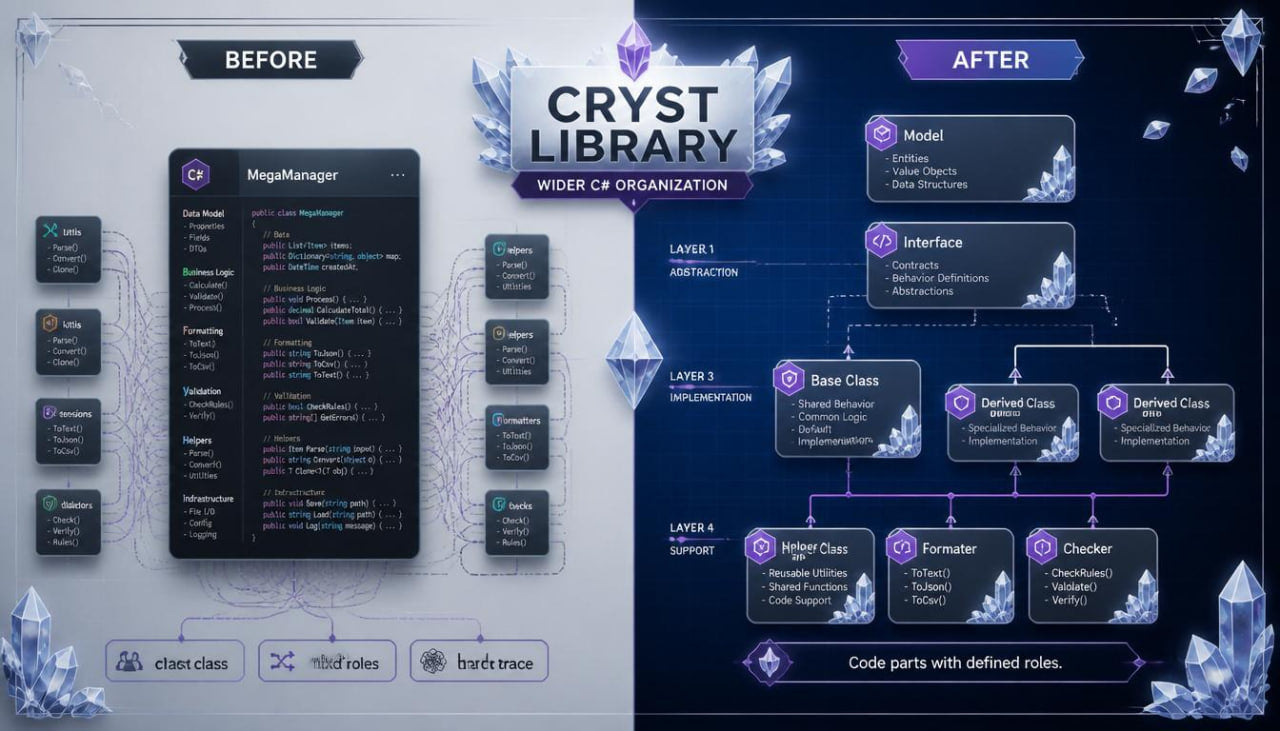
After learners study values, methods, classes, collections, issue review, and data flow, they often need a clearer way to read larger C# examples. A single class may be understandable, but several classes working together can feel harder to follow. Learners may see interfaces, inheritance, shared behavior, separate responsibilities, and layered files without knowing how each part relates to the others. This can make organized code look more complicated than it needs to be. Cryst Library was created to help learners study wider C# structure through careful explanations, compact examples, and guided review tasks. -
Solution
Cryst Library arranges intermediate C# organization topics into written modules that build from familiar class ideas toward connected code sections. The course explains how classes can share structure, how interfaces describe expected behavior, and how related code can be divided into smaller roles. It uses short examples first, then combines them into wider reading tasks. Each topic includes notes, examples, practical prompts, and recap pages for review. The course helps learners read connected C# material with more structure and less confusion. -
What’s Inside
Cryst Library begins with an orientation section that explains how the course is arranged. Learners are introduced to the main study method used throughout the material: identify each code part, describe its role, trace how it connects to another part, and review the full example after each module. The opening section also explains that this tier builds on earlier Talvoryx materials, especially classes, objects, methods, collections, validation, and data flow.
The first module reviews class structure in a broader context. Instead of looking at one class alone, learners study why a C# example may contain several classes. The course explains how one class may describe a simple data shape, another may process that data, and another may organize a result. Small examples show how each class can have a narrow purpose. Learners are asked to label class names, properties, methods, and the role each class plays in the example.
The next module introduces the idea of responsibility in code. This section explains why placing every action in one class can make code harder to read. Learners study short before-and-after examples where a crowded class is divided into smaller pieces. The goal is not to introduce heavy design theory, but to help learners notice when a class is doing too many unrelated things. Practice prompts ask learners to describe what a class is responsible for and what could be placed somewhere else.
A full section is dedicated to interfaces. Learners study interfaces as descriptions of behavior that a class can follow. The course explains interface names, method signatures, properties, and implementation through small examples. It shows how an interface can describe what a class should provide without filling in every detail itself. The material keeps the topic practical by using simple examples such as formatters, checkers, readers, or calculators. Learners compare an interface with the class that follows it and identify which members must be present.
Cryst Library then introduces inheritance. This module explains how one class can receive members from another class and how shared structure can reduce repeated code in study examples. Learners explore base classes, derived classes, shared properties, and overridden methods in a careful order. The course also explains that inheritance should be read thoughtfully, because shared behavior can be helpful in one example and unclear in another. Tasks ask learners to identify the base class, derived class, shared members, and custom members.
A comparison module places interfaces and inheritance side by side. Learners study when an example describes shared behavior through an interface and when it describes shared structure through a base class. The course avoids rigid rules and instead focuses on reading clues in the code. Does the class follow a behavior contract? Does it reuse shared fields or methods? Does the example need different classes to be handled through the same shape? These questions help learners examine the structure with a practical eye.
The next section explores polymorphism in beginner-friendly language. Learners study how different classes can be handled through a shared type when they follow the same interface or inherit from the same base class. Examples remain compact, such as a list of items that can each produce a description or calculate a small value. The course shows how a loop can call the same method name while each object responds according to its own class. This section connects strongly with collection and object reading from earlier tiers.
Cryst Library also includes a module on layered examples. Learners study how a small C# example can be divided into data models, service-style classes, validation helpers, and formatting helpers. The material explains these roles in plain language. A data model holds information. A checker reviews whether information fits a rule. A formatter arranges information into a readable line. A service-style class may coordinate several small actions. The course shows how these pieces can work together without making the example too large.
A separate section covers dependency-style reading. This module explains that one class may use another class to complete part of its work. Learners study constructor parameters, stored helper objects, and method calls between classes. The course presents this as a reading skill: when a class uses another class, trace where that helper comes from and what role it plays. Practice tasks ask learners to follow the path from object creation to method use.
The next module focuses on abstraction. Learners study how C# examples can hide smaller details behind a clearer name or shared shape. This section connects interfaces, methods, helper classes, and organized naming. The course explains abstraction as a way to talk about what code does without reading every small line at once. Learners examine examples where a method name or interface name gives a higher-level description of a task.
Cryst Library also includes a section on naming and folder-style grouping in general terms. It does not refer to third-party tools or outside services. Instead, it explains how course examples may group related files or code sections by topic, role, or feature area. Learners study names that describe purpose, names that cause confusion, and ways to keep related material together. This section is useful for reading larger examples because names often guide the learner through the structure.
A practical reading module brings the course topics together. Learners are given connected examples with classes, interfaces, inheritance, collections, helper methods, and validation checks. They are guided to read one part at a time. First, they identify the data model. Then they identify shared behavior. Next, they trace which class performs which action. Finally, they follow a value through the connected code. These tasks help learners study C# examples that are wider than earlier tiers but still arranged in a manageable way.
The course includes task pages after each major topic. Some tasks ask learners to complete an interface implementation. Others ask them to identify inherited members, trace polymorphic method calls, describe class responsibility, or reorganize a crowded example into smaller sections. There are also comparison tasks where learners decide whether a structure is using an interface, inheritance, a helper method, or a simple class relationship.
The recap section gathers all main ideas into organized review notes. Learners can revisit class responsibility, interfaces, inheritance, polymorphism, helper classes, abstraction, connected objects, layered examples, and naming. These recap pages are written in compact blocks so learners can review one topic at a time.
The glossary explains key terms used in Cryst Library. Terms include interface, implementation, base class, derived class, inheritance, override, polymorphism, abstraction, responsibility, helper class, service-style class, dependency, shared type, model, validation helper, formatter, and layered structure. Each definition connects to examples from the course so learners can understand the term through practical context.
-
Who Is This For?
Cryst Library is for learners who already understand classes, objects, collections, validation, and data flow, and now want to study wider C# organization. It is suitable for learners who can read one class but feel less certain when several classes, interfaces, and helper sections appear together.
This course may also suit learners who want to move beyond small examples while staying within a structured written format. Cryst Library does not rely on oversized projects or dramatic claims. It gives learners a careful route through connected C# structure, with examples that grow gradually.
It is also useful for learners who want to understand why code is divided into multiple roles. If a learner has wondered why an example uses interfaces, base classes, helper methods, or separate model classes, this tier gives those topics focused attention.
Cryst Library is a good fit for learners who enjoy organized study materials, comparison tables, glossary notes, and line-by-line reading tasks. The course supports thoughtful C# study without pressure-based language or unrealistic claims.
- What You’ll Learn
- How several C# classes can work together in one example
- How to identify the responsibility of a class
- How interfaces describe behavior that classes can follow
- How a class implements an interface
- How inheritance connects base classes and derived classes
- How overridden methods appear in simple examples
- How polymorphism works through shared types
- How helper classes can organize smaller tasks
- How data models, checkers, and formatters can be separated
- How one class can use another class to complete part of its work
- How abstraction can make code easier to describe
- How naming supports code reading
- How to trace values through connected C# sections
- How to compare interfaces, inheritance, helper methods, and class relationships
- How to use recap notes and glossary pages for review
-
Refund Note
For paid Talvoryx tiers, the store may provide a 30-day refund window according to the policy shown during checkout and on the store policy pages. Please review the refund terms before placing an order, because handling may depend on order details, delivery status, and the selected digital course materials.
Self-paced learning overview
- 💾 Digital file available after purchase
- 🗂️ Long-term availability
- 🔐 Secure checkout
- 🗓️ Content updated in 2026
What format are Talvoryx courses provided in?
What format are Talvoryx courses provided in?
Talvoryx courses are written digital study materials arranged into modules, examples, short tasks, notes, and review pages. The format is made for reading, checking examples, and returning to earlier sections when needed.
Do I need prior C# experience?
Do I need prior C# experience?
No prior C# study is required for the starting tiers. Wider tiers add broader topic coverage, but each Talvoryx course keeps the structure organized and suitable for steady learning.
How should I study the materials?
How should I study the materials?
You can move through the course page by page, pause after each example, complete the tasks, and use the recap notes for review. The materials are designed to support a calm study rhythm without pressure-based claims.
Share