Talvoryx
Drift Capsule
Drift Capsule
Couldn't load pickup availability
-
Problem Statement
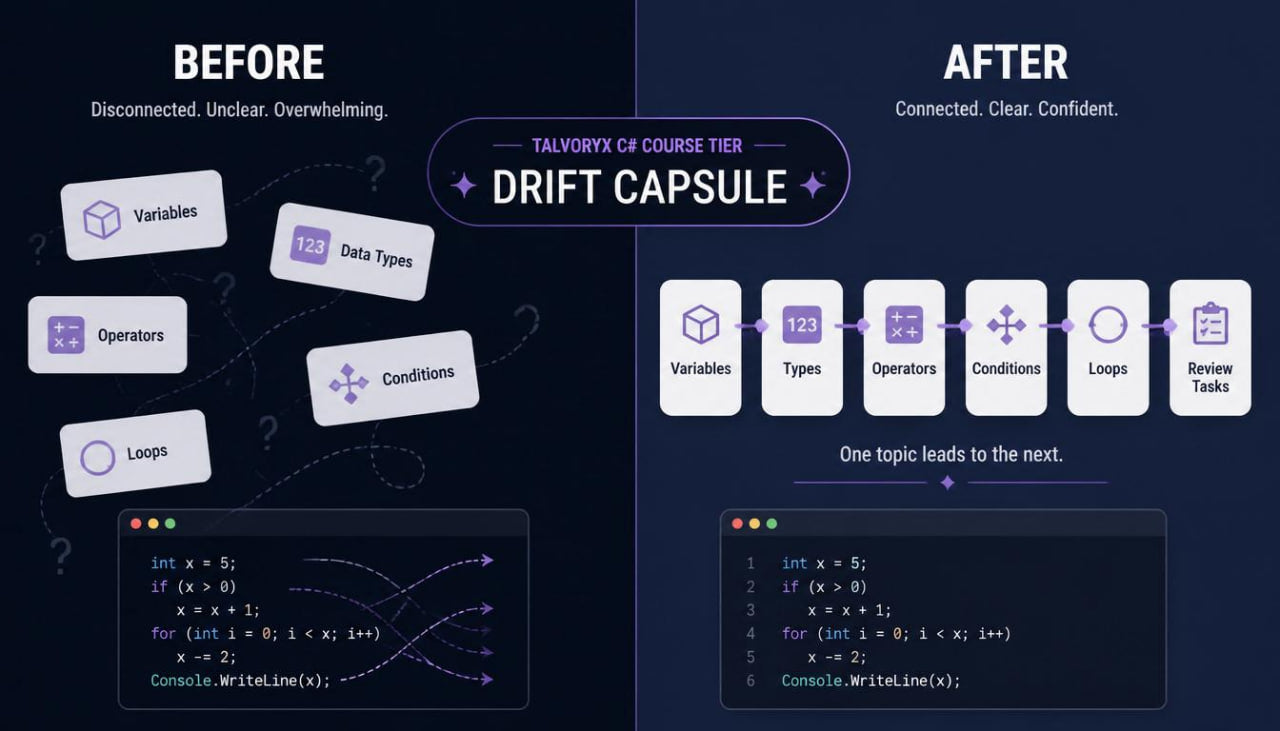
After a first look at C# syntax, many learners want to continue but are unsure which topic should come next. They may understand single lines of code, yet feel uncertain when several lines begin working together. Conditions, loops, and value changes can appear confusing when they are introduced without enough context. Some learners also need more written practice before moving into larger code examples. Drift Capsule was created to give these early topics a more organized study route. -
Solution
Drift Capsule arranges beginner C# topics into compact modules that connect one idea to the next. The course starts with familiar syntax ideas, then gradually adds variables, expressions, comparisons, branches, and repeated actions. Each module includes written explanations, examples, review notes, and small tasks for reading and rewriting code. The goal is to help learners build a steadier understanding of how basic C# instructions work together. Instead of rushing into large projects, Drift Capsule keeps the focus on careful reading, practical examples, and topic-by-topic learning. -
What’s Inside
Drift Capsule begins with a short orientation section that explains how the course is arranged. Learners are introduced to the module layout, example style, task format, and review pages. This opening section helps set the study rhythm before the main C# material begins.
The first module reviews the structure of simple C# code. It revisits statements, braces, semicolons, indentation, and short code blocks. This review is not a repeat of Free Unit in the same form; it adds more context by showing how several statements can appear together. Learners see how code can be read from top to bottom and how small details affect the meaning of a line.
The next module focuses on variables and data types. It explains how named values are used to store information while code runs. Learners study common beginner data categories such as whole numbers, decimal-style values, text, characters, and true-or-false values. The course also explains why type choice matters, how names can make code easier to read, and how values can be changed in simple examples. Practice prompts ask learners to identify value types, improve variable names, and describe what a short statement is doing.
A separate section covers expressions and operators. This part shows how C# can calculate, compare, combine, and assign values. Learners meet arithmetic operators, comparison operators, and simple logical operators in short examples. The course explains how an expression can produce a result and how that result may be stored, checked, or printed in a later line. The material also includes small “read the line” tasks, where the learner explains the meaning of a statement in plain language.
Drift Capsule then introduces conditional logic. This module explains how code can choose between different paths based on a condition. Learners study if statements, else branches, and simple nested conditions. The examples are intentionally small, using everyday-style values such as scores, quantities, names, or status flags. The course shows how a condition is written, how it is checked, and how the chosen branch affects the next part of the code. Review notes help learners compare a condition, a branch, and a result.
The next module introduces loops. It explains why repeated actions are useful and how repetition can reduce repeated writing inside code. Learners study beginner-friendly loop examples that count numbers, read through simple ranges, or repeat a small action while a condition remains true. The course introduces loop parts carefully: starting value, condition, update, and body. Instead of presenting loops as abstract syntax only, Drift Capsule explains what changes after each pass through the loop.
A practical reading section brings conditions and loops together. Learners examine short code samples where values change, conditions are checked, and repeated actions produce a final result. These examples are written to encourage careful tracing. The learner may be asked to follow a variable line by line, mark when a branch runs, or count how many times a loop body is used. This section helps connect earlier topics into a more readable whole.
Drift Capsule also includes short task pages. These tasks are written as study prompts rather than formal tests. Some ask the learner to complete a missing condition. Others ask them to rename variables, identify the result of an expression, compare two code fragments, or explain what a loop does. The goal is to keep the learner active while still keeping the course calm and approachable.
A recap section appears after the main modules. It gathers key ideas from the course into organized notes. Learners can review variable types, expression patterns, branch structure, and loop structure in one place. The recap is useful for returning to the material after a break or before moving to a wider Talvoryx tier.
The course ends with a glossary and review checklist. The glossary explains terms such as variable, type, operator, expression, condition, branch, loop, iteration, comparison, and boolean value. The checklist gives learners a way to review what they have studied without making exaggerated claims about outcomes. It simply helps them see which topics they have read and which sections they may want to revisit.
-
Who Is This For?
Drift Capsule is for learners who have completed a small introduction to C# or who want a beginner course with more structure than a sample tier. It is suitable for someone who can recognize basic code symbols but wants more practice reading how values, conditions, and loops work together.
This course may also suit learners who prefer written materials over scattered notes. Drift Capsule keeps related ideas close together, so variables lead into expressions, expressions lead into comparisons, and comparisons lead into branching. This arrangement can help learners study with a more organized rhythm.
It is also a good choice for learners who want to review early C# ideas before studying classes, methods, collections, or larger examples. Drift Capsule does not try to cover every part of C#. Instead, it gives attention to the early building blocks that appear often in later study.
Learners who enjoy code reading, short written tasks, and recap pages may find this tier especially useful. It is not made around pressure, hype, or inflated claims. It is a steady beginner course for understanding the first moving parts of C# code.
- What You’ll Learn
- How basic C# statements work together inside small code blocks
- How variables store values and make examples easier to read
- How common beginner data types appear in C# examples
- How expressions produce values through operators
- How comparison operators are used in simple decisions
- How if and else branches create different code paths
- How loops repeat actions while values change
- How to trace a variable through several lines of code
- How to read small examples that combine conditions and loops
- How to use recap notes and glossary pages for review
- How to complete short C# study tasks based on beginner syntax
- How to describe small code fragments in plain language
-
Refund Note
For paid Talvoryx tiers, the store may provide a 30-day refund window according to the policy shown during checkout and on the store policy pages. Please review the refund terms before placing an order, because handling may depend on order details, delivery status, and the selected digital course materials.
Self-paced learning overview
- 💾 Digital file available after purchase
- 🗂️ Long-term availability
- 🔐 Secure checkout
- 🗓️ Content updated in 2026
What format are Talvoryx courses provided in?
What format are Talvoryx courses provided in?
Talvoryx courses are written digital study materials arranged into modules, examples, short tasks, notes, and review pages. The format is made for reading, checking examples, and returning to earlier sections when needed.
Do I need prior C# experience?
Do I need prior C# experience?
No prior C# study is required for the starting tiers. Wider tiers add broader topic coverage, but each Talvoryx course keeps the structure organized and suitable for steady learning.
How should I study the materials?
How should I study the materials?
You can move through the course page by page, pause after each example, complete the tasks, and use the recap notes for review. The materials are designed to support a calm study rhythm without pressure-based claims.
Share