Talvoryx
Nexus Library
Nexus Library
Couldn't load pickup availability
-
Problem Statement
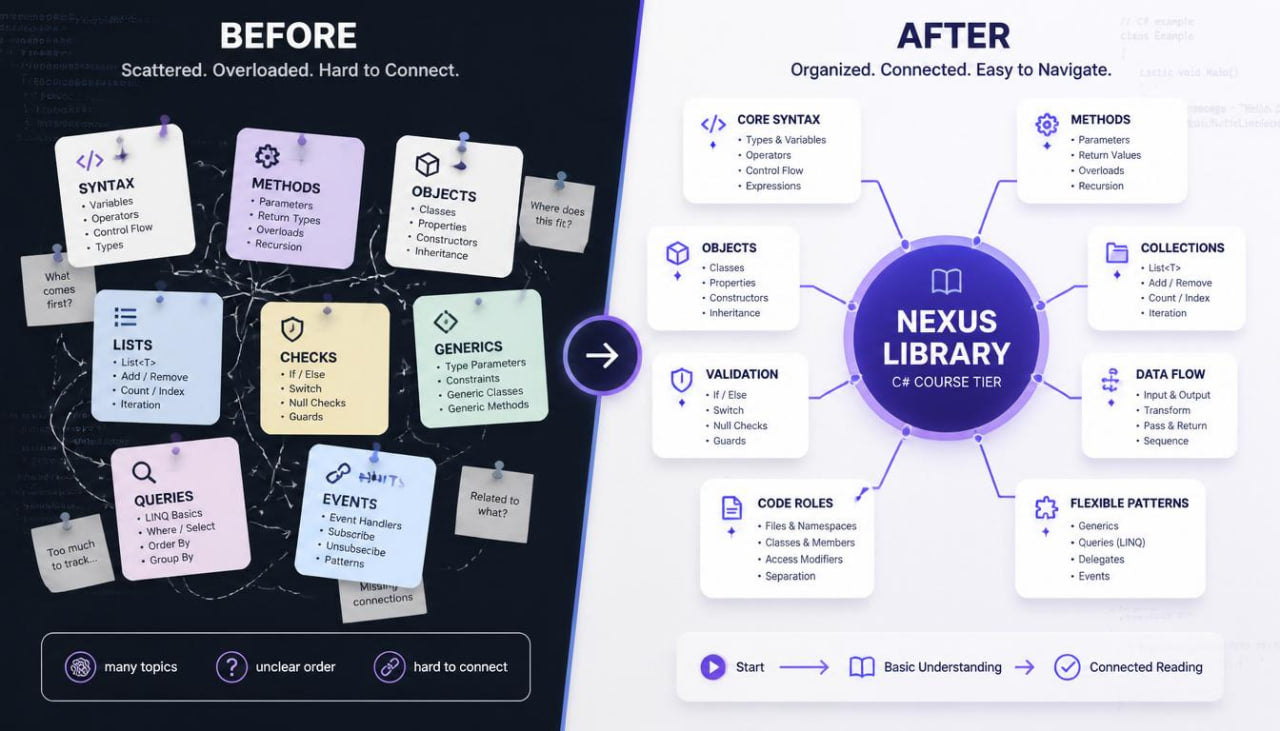
After studying many separate C# topics, learners often need help seeing how everything connects inside wider examples. Variables, methods, classes, lists, validation, interfaces, generics, queries, and events may each make sense alone, but they can feel harder to follow when combined. A learner may read a larger C# example and lose track of where information begins, where it changes, and which code part uses it later. It can also be difficult to decide which topic needs review when several ideas appear on the same page. Nexus Library was created to gather a broad C# study path into one organized course tier with careful explanations and connected practice. -
Solution
Nexus Library gives learners a structured route through a wide set of C# materials, starting with core syntax review and moving toward connected code reading. The course combines written modules, example pages, task prompts, comparison notes, recap sections, and glossary references. Each topic is linked to earlier ideas so learners can see how values, decisions, methods, objects, collections, and coordination patterns work together. Larger examples are divided into smaller reading stages, helping learners identify one code role at a time. The course supports steady study by turning broad C# material into an arranged learning library. -
What’s Inside
Nexus Library begins with a course orientation section. This opening part explains how the full tier is arranged, how to move through the modules, and how to use recap pages for review. Learners are encouraged to study in sections rather than treating the entire library as one large block. The orientation also introduces a reading method used across the course: identify the code part, describe its role, trace the value path, review the result, and return to glossary notes when a term appears again.
The first main section reviews C# syntax foundations. It revisits statements, braces, semicolons, indentation, expressions, variables, data types, and simple comparisons. This review is not written as a beginner-only repeat. Instead, it places early syntax inside a wider context, showing why small details still matter when examples become larger. Learners complete short reading tasks that ask them to label statements, explain value changes, and identify how a line affects the following section.
The next module reviews conditions and loops. Learners study branching paths, comparison rules, repeated actions, loop boundaries, counters, and boolean checks. The course includes compact examples where conditions and loops work with single values, then expands into examples that use lists and objects. This helps learners connect early control flow with later collection and object-based patterns.
A method-focused module follows. It revisits method structure, method calls, parameters, arguments, return values, void methods, and scope. Nexus Library gives special attention to value movement: what enters the method, what happens inside, what comes back, and where the result is used. Learners study examples where several methods divide a larger task into smaller named sections. Practice prompts ask learners to trace parameters, choose return types, and explain method roles in plain language.
The class and object section brings together fields, properties, constructors, object creation, and methods inside classes. Learners read examples where objects store related values and provide small actions connected to those values. The course also reviews constructor flow, property updates, and object state. This module is important because later sections use objects inside lists, helper classes, and layered examples.
A collection module expands the earlier object work into arrays, lists, indexing, counting, foreach-style reading, and item updates. Learners study how groups of values are stored and reviewed. The course includes examples with numbers, text values, and objects. It also explains how collection size, item position, and loop conditions connect. Guided tasks ask learners to trace a list before and after items are added, removed, or checked.
Nexus Library includes a data flow section that connects text handling, validation, type conversion ideas, structured records, and formatted results. Learners study examples where information begins as text, passes through checks, becomes a value or object, enters a collection, and appears in a summary. The section gives careful attention to each stage of movement so learners can describe the full path without guessing.
A review module on issue reading and validation is also included. Learners revisit syntax issues, type mismatches, null-related checks, collection boundaries, method input checks, and simple exception handling. The course explains how to compare expected behavior with actual behavior and how to use error messages as reading clues. Tasks ask learners to inspect short examples, identify the issue pattern, and describe a careful adjustment.
The next major section focuses on code organization. Learners study class responsibility, helper methods, helper classes, model-style classes, validation helpers, and formatting helpers. The material explains how separate parts can keep a wider example more readable. Learners compare crowded examples with versions divided into smaller roles. The aim is to help them describe what each class or method is responsible for.
Nexus Library then includes a module on interfaces and inheritance. Learners review how interfaces describe behavior that classes can follow, and how inheritance can share structure across related classes. The course includes comparison pages that show interface examples beside inheritance examples. Learners are asked to identify shared members, implemented members, overridden methods, and common reading clues.
A polymorphism section builds on that material. Learners study how different objects can be handled through a shared type when they follow the same interface or inherit from the same base class. The course uses lists of related objects and shared method calls to show how this appears in readable examples. Each example is broken into source object, shared type, method call, and class-specific response.
The generics module introduces type placeholders, generic methods, generic classes, and simple constraint ideas. Learners study how one structure can work with different value types while keeping type rules clear. The course uses small examples such as holders, pairs, result containers, and reusable method shapes. Practice tasks ask learners to identify the placeholder type, the actual type, and the values moving through the structure.
A query-style reading section follows. Learners study filtering, selection, projection, ordering, grouping, and result shaping with collections. The course compares loop-based reading with query-style reading so learners can connect newer syntax to familiar control flow. Examples include object lists that are filtered by property values, shaped into labels, sorted by numbers, or grouped by a shared category.
Nexus Library also includes a module on delegates, lambda-style expressions, and events. Learners study how actions can be described, passed, stored, and triggered in organized examples. The course explains method signatures, inline expressions, event signals, and response methods in carefully separated sections. The focus stays on reading how an action connects to another part of the code.
A connected example section brings the whole course together. Learners work through wider written examples that include objects, lists, validation, helper classes, interfaces, generic structures, query-style operations, and event-based responses. Each example is divided into stages: data shape, storage, checking, selection, action, response, and result. This gives learners a guided way to read broad C# material without treating every line as equally important at once.
The task library includes review prompts for many topic groups. Some tasks ask learners to complete missing code parts. Others ask them to label roles, trace values, compare structures, explain a method, identify a class responsibility, follow an event response, or summarize a query result. The tasks are written for study and review, not pressure.
The recap library gathers topic summaries into organized pages. Learners can return to syntax, variables, methods, classes, collections, validation, data flow, organization, interfaces, inheritance, generics, query-style reading, delegates, events, and connected examples. The glossary includes terms from across the full course tier, making Nexus Library a broad reference-style course for Talvoryx learners.
-
Who Is This For?
Nexus Library is for learners who want the widest Talvoryx C# course tier and prefer written materials with detailed structure. It is suitable for learners who have already studied some C# topics and want to connect them into a broader reading path.
This tier may also suit learners who want one organized place for many C# study themes. Instead of studying only one narrow topic, Nexus Library brings together syntax, methods, objects, collections, validation, data flow, code organization, and flexible structures. The material is still divided into modules, so learners can review one topic at a time.
Nexus Library is a good fit for learners who enjoy tracing connected examples. If a learner wants to follow values from input-style text into objects, lists, helper methods, query results, and event responses, this tier gives dedicated practice for that kind of reading.
It is also suitable for learners who prefer calm, careful educational materials without exaggerated promises. The course focuses on knowledge, examples, tasks, and review pages.
- What You’ll Learn
- How core C# syntax connects with wider examples
- How variables, expressions, conditions, and loops support later topics
- How methods receive, use, and return information
- How scope affects value reading inside methods and blocks
- How classes, objects, properties, and constructors work together
- How arrays and lists store grouped values
- How loops and foreach-style reading move through collections
- How validation checks guide code paths
- How to read common issue patterns and error messages
- How information moves through text handling, objects, lists, and summaries
- How helper methods and helper classes divide responsibilities
- How interfaces describe shared behavior
- How inheritance shares structure across related classes
- How polymorphism appears through shared types
- How generic methods and classes use type placeholders
- How query-style expressions filter, shape, order, and group data
- How delegates describe action shapes
- How lambda-style expressions are read in plain language
- How events connect signals with response methods
- How to trace broad C# examples in smaller reading stages
- How to use recap pages and glossary notes for long-term review
-
Refund Note
For paid Talvoryx tiers, the store may provide a 30-day refund window according to the policy shown during checkout and on the store policy pages. Please review the refund terms before placing an order, because handling can depend on order details, delivery status, and the selected digital course materials.
Self-paced learning overview
- 💾 Digital file available after purchase
- 🗂️ Long-term availability
- 🔐 Secure checkout
- 🗓️ Content updated in 2026
What format are Talvoryx courses provided in?
What format are Talvoryx courses provided in?
Talvoryx courses are written digital study materials arranged into modules, examples, short tasks, notes, and review pages. The format is made for reading, checking examples, and returning to earlier sections when needed.
Do I need prior C# experience?
Do I need prior C# experience?
No prior C# study is required for the starting tiers. Wider tiers add broader topic coverage, but each Talvoryx course keeps the structure organized and suitable for steady learning.
How should I study the materials?
How should I study the materials?
You can move through the course page by page, pause after each example, complete the tasks, and use the recap notes for review. The materials are designed to support a calm study rhythm without pressure-based claims.
Share