Talvoryx
Slate Node
Slate Node
Couldn't load pickup availability
-
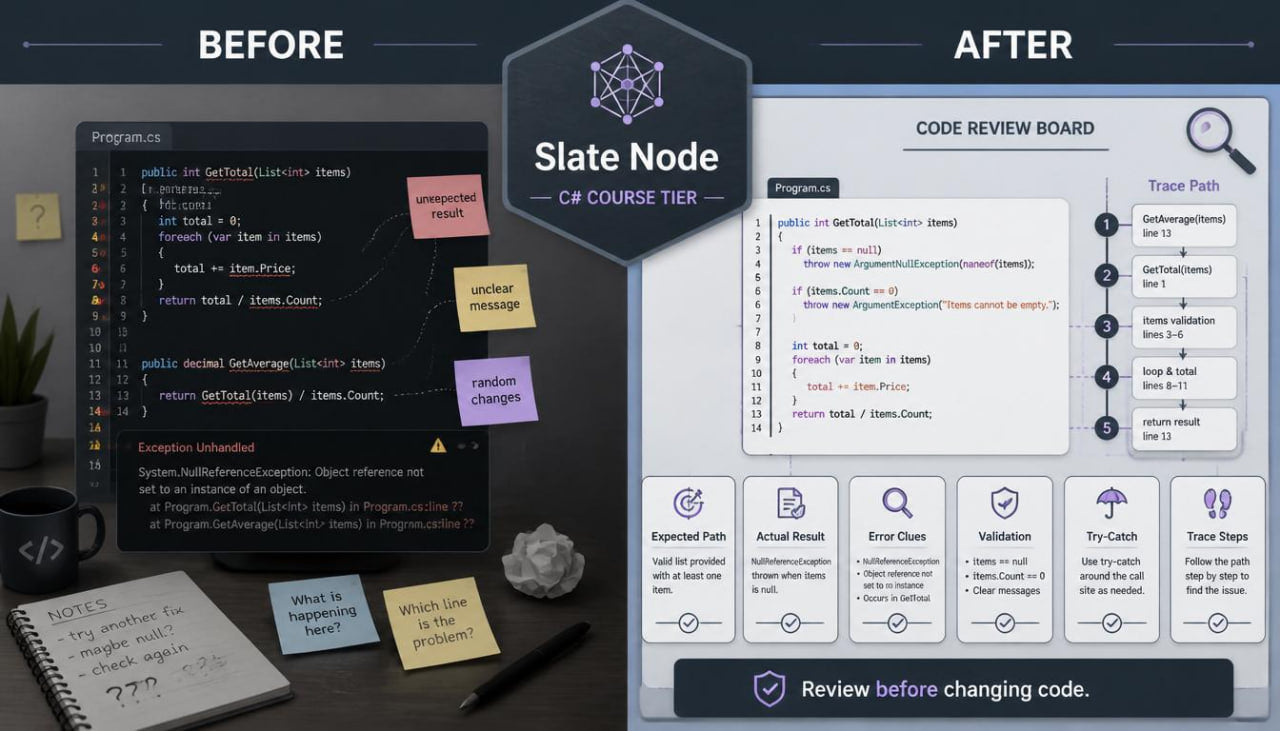
Problem Statement
After learners study variables, methods, classes, and collections, they often meet examples where code does not behave as expected. A value may be missing, a number may be outside the intended range, a collection may be empty, or a method may receive information in the wrong shape. Beginners can feel unsure when an error message appears because the message may include unfamiliar terms and line references. Some learners also focus only on fixing one line without understanding why the issue happened in the first place. Slate Node was created to help learners read problems in C# examples with more structure, patience, and practical review steps. -
Solution
Slate Node introduces error-aware C# study through written modules, compact examples, review prompts, and guided reading tasks. The course explains how to notice common issue patterns, read error messages, use conditions for basic validation, and understand try-catch structure in small examples. It also shows how learners can trace values before a problem appears, compare expected behavior with actual behavior, and review code in a more organized way. Each section connects with earlier topics such as variables, loops, methods, classes, and lists. The course keeps examples focused so learners can study the reason behind an issue rather than only looking at the final error line. -
What’s Inside
Slate Node begins with an orientation section that explains how the course is arranged. Learners are introduced to the main study rhythm used throughout the material: read the example, identify the expected path, notice where the path changes, review the message or result, and describe the issue in plain language. This opening section also explains that the course is not about creating large systems. It is about learning how to inspect small C# examples and understand why they behave differently than expected.
The first main module introduces the idea of expected and actual behavior. Learners compare what a short code example appears to be doing with what it actually produces. The material uses beginner-friendly examples involving values, conditions, loops, and list items. A line may look correct at first glance, but a comparison may use the wrong operator, a loop may stop too early, or a value may never be changed. This section helps learners slow down and describe behavior before looking for a correction.
The next module focuses on reading error messages. It explains that an error message often contains clues such as a line number, a type name, a missing symbol, or a description of what C# could not understand. Learners study small examples with common beginner issues such as missing semicolons, mismatched braces, wrong variable names, type mismatches, or method calls with the wrong number of arguments. The course does not overload the learner with long lists. Instead, it shows how to separate the message into smaller clues and connect those clues to the related code line.
A full section is dedicated to syntax issues. This module reviews structural details such as braces, parentheses, semicolons, quotation marks, commas, and block placement. Learners study examples where one missing mark changes how code is read. The material explains how a small symbol can affect a larger section, especially when braces or parentheses are involved. Practice prompts ask learners to inspect short fragments and identify which part of the structure is incomplete or misplaced.
Slate Node then moves into type-related issues. This module explains how C# expects values to match the type being used. Learners read examples involving numbers, text values, true-or-false values, arrays, lists, and method return types. The course explains how a value can be valid in everyday language but still not match the type expected by a variable, property, or parameter. Tasks ask learners to match values with types, identify type conflicts, and rewrite small lines so the value and type align.
The next section introduces validation. Learners study how conditions can check a value before code continues. Examples include checking whether a number is within a range, whether text is empty, whether a list contains items, or whether a value meets a simple rule. The course explains validation as a reading habit: before using a value, ask whether the value is in a usable shape. This section connects strongly with earlier condition and collection topics.
A separate module covers null-related thinking in a beginner-friendly way. The course explains that some values may not refer to an existing object or may not have a usable value in a given moment. Learners read short examples where an object, text value, or collection reference is checked before use. The module uses careful explanations and avoids heavy theory. The focus is on recognizing why code may need to check whether something is present before reading from it.
Slate Node also introduces exception handling through small try-catch examples. The course explains that some operations may run into problems while the code is running, and a try-catch structure can describe how the code responds. Learners study the shape of a try block, the purpose of a catch block, and how a simple message can be handled in a controlled example. The material keeps the examples compact, such as converting text into a number, reading from a collection position, or handling an unexpected value. The goal is to understand the structure and purpose, not to cover every exception type.
The next module focuses on collection-related issues. Learners study examples where an index is outside the valid range, a list is empty, or a loop uses the wrong boundary. This section builds on Cipher Pattern by showing how grouped values can create their own issue patterns. Learners trace indexes, count values, and compare loop conditions with collection size. Practice tasks ask learners to decide whether an index is valid and whether a loop visits the intended items.
A method-focused section follows. This module studies issues involving parameters, return values, and method calls. Learners review examples where a method receives a value that does not fit the intended rule, returns a value that is not used, or is called with missing information. The course helps learners trace information from the call into the method body and back to the calling line. This supports careful reading of method behavior, especially when several small methods appear together.
Slate Node also includes a class and object review section. Learners study issues involving constructor values, property updates, and object state. For example, an object may be created with an empty name, a number may not be checked before being stored, or a method may depend on a property that has not been set. The course explains how object values can affect later behavior. It also includes short tasks where learners identify which property or constructor parameter may need review.
A practical inspection module brings the course together. Learners are given small C# examples with one or two issue patterns. They are asked to read the expected behavior, trace the code, identify the line that changes the outcome, and describe the issue. Some examples include syntax issues, some include type mismatch, some include list boundaries, and others include missing validation. The tasks encourage careful written reasoning rather than guessing.
The course includes review notes after each major section. These notes summarize common issue patterns in compact language. Learners can return to sections on syntax, types, validation, null checks, exceptions, collections, methods, and objects. The recap pages are arranged so the learner can review one topic without rereading the full course.
The glossary explains terms used throughout Slate Node. Terms include error message, syntax issue, type mismatch, validation, exception, try block, catch block, null value, index range, boundary, expected behavior, actual behavior, trace, parameter check, and object state. Each term is connected to small examples from the course so the vocabulary remains tied to practical reading.
-
Who Is This For?
Slate Node is for learners who have studied core C# topics and now want to understand what happens when code examples behave differently than expected. It is suitable for learners who can read variables, methods, classes, and lists, but feel uncertain when error messages or unexpected results appear.
This course is also useful for learners who want a more careful review habit. Instead of changing lines randomly, Slate Node encourages learners to describe the expected behavior, trace the actual path, and connect the issue to a specific code part. This can make study sessions feel more organized and less scattered.
Slate Node may also suit learners preparing for larger C# materials where validation, exception handling, and issue review appear more often. It does not turn debugging into a dramatic promise. It simply gives learners structured pages for reading issues, checking values, and studying common patterns.
This tier is a strong fit for learners who like written examples, line-by-line tracing, and practical review prompts. It supports careful code reading and helps learners develop a calmer method for studying code behavior.
- What You’ll Learn
- How to compare expected behavior with actual behavior
- How to read common C# error messages in smaller parts
- How missing symbols can affect code structure
- How type mismatches appear in beginner examples
- How validation checks can review values before use
- How null-related checks appear in simple C# code
- How try-catch structure is arranged in small examples
- How collection indexes can move outside a valid range
- How loop boundaries affect collection reading
- How method parameters and return values can create issue patterns
- How object values can affect later behavior
- How to trace code before changing a line
- How to describe an issue in plain language
- How to use recap pages and glossary notes for review
-
Refund Note
For paid Talvoryx tiers, the store may provide a 30-day refund window according to the policy shown during checkout and on the store policy pages. Please review the refund terms before placing an order, because handling may depend on order details, delivery status, and the selected digital course materials.
Self-paced learning overview
- 💾 Digital file available after purchase
- 🗂️ Long-term availability
- 🔐 Secure checkout
- 🗓️ Content updated in 2026
What format are Talvoryx courses provided in?
What format are Talvoryx courses provided in?
Talvoryx courses are written digital study materials arranged into modules, examples, short tasks, notes, and review pages. The format is made for reading, checking examples, and returning to earlier sections when needed.
Do I need prior C# experience?
Do I need prior C# experience?
No prior C# study is required for the starting tiers. Wider tiers add broader topic coverage, but each Talvoryx course keeps the structure organized and suitable for steady learning.
How should I study the materials?
How should I study the materials?
You can move through the course page by page, pause after each example, complete the tasks, and use the recap notes for review. The materials are designed to support a calm study rhythm without pressure-based claims.
Share